Canada continues to be one of the most popular immigration destinations for skilled workers, students, entrepreneurs and families from South Asia. For applicants from Pakistan, India, Bangladesh, Sri Lanka and nearby countries, the attraction is clear: a stable economy, permanent residence opportunities, quality education, healthcare access and strong South Asian communities across major Canadian cities.
According to Statistics Canada’s 2021 Census, more than 303,000 people reported Pakistani ethnic or cultural origin, while South Asians were the largest racialized group in Canada, with more than 2.57 million people. Canada’s 2026 immigration levels plan also sets a target of 380,000 new permanent residents, showing that immigration remains an important part of the country’s workforce and population strategy.
For skilled professionals and families from cities such as Karachi, Lahore, Delhi, Dhaka and Colombo, Canada offers several possible routes to permanent residence. The right pathway depends on your education, work experience, language score, age, occupation, family situation and long-term settlement plan.
Main Canada Immigration Pathways in 2026
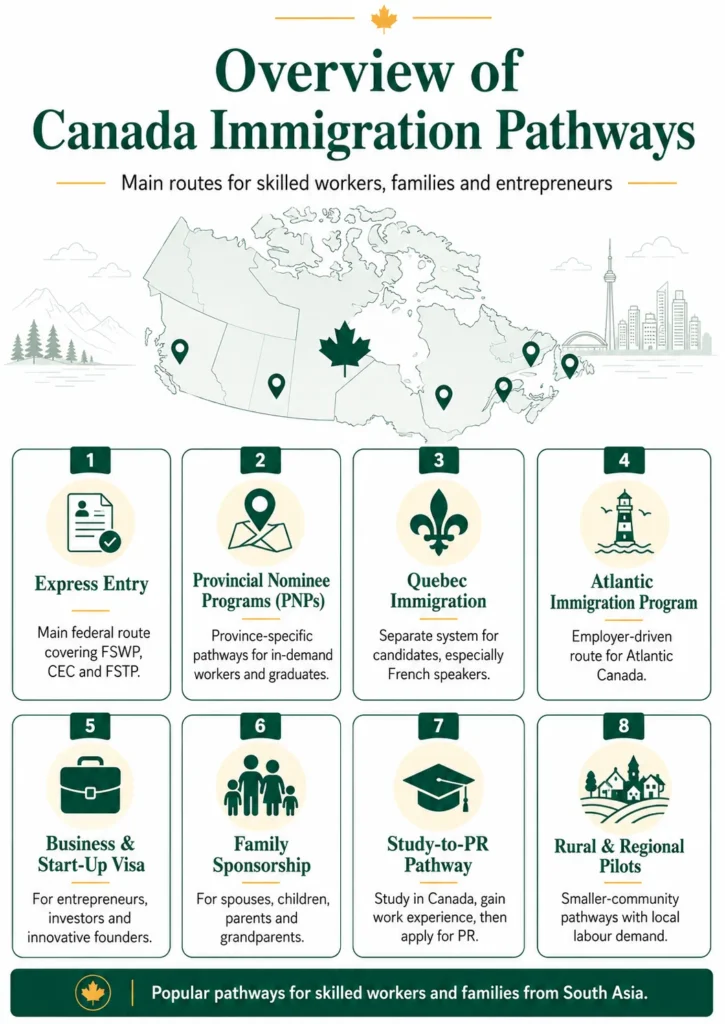
Canada has many immigration routes, but most applicants usually fall into one of these main categories:
| Pathway | Best For | Key Requirement |
|---|---|---|
| Express Entry | Skilled workers with strong education, language and work experience | CRS score and eligibility for one of the federal programs |
| Provincial Nominee Program | Applicants whose skills match a province’s labour needs | Provincial nomination or job offer, depending on stream |
| Quebec Immigration | French-speaking applicants or those interested in Quebec | Quebec selection process and CSQ |
| Atlantic Immigration Program | Workers with job offers in Atlantic Canada | Job offer from a designated employer |
| Study-to-PR Route | International students planning to study and work in Canada | Study permit, eligible program and PGWP planning |
| Family Sponsorship | Spouses, children, parents and grandparents | Eligible Canadian sponsor |
| Business and Entrepreneur Routes | Entrepreneurs and investors | Program availability, capital and business plan |
| Rural and Caregiver Pathways | Workers open to smaller communities or care roles | Job offer and program-specific eligibility |
Express Entry: The Main Route for Skilled Workers
Express Entry is one of the most popular immigration systems for skilled workers who want to become permanent residents of Canada. It is not one single visa program. Instead, it is an online application management system used for three federal immigration programs:
- Federal Skilled Worker Program
- Canadian Experience Class
- Federal Skilled Trades Program
For many South Asian applicants applying from outside Canada, the Federal Skilled Worker Program is usually the most relevant option.
Federal Skilled Worker Program
The Federal Skilled Worker Program is designed for applicants with skilled work experience outside Canada. It is suitable for professionals such as IT specialists, accountants, engineers, marketing professionals, healthcare workers, finance professionals and other skilled workers.
To qualify, applicants generally need:
Skilled work experience: You need at least one year of continuous paid full-time work experience, or an equivalent amount of part-time work, in a skilled occupation under TEER 0, 1, 2 or 3 of Canada’s National Occupational Classification system.
Language test results: You must prove your English or French ability through an approved language test. For English, accepted tests include IELTS General Training and CELPIP General. For French, TEF Canada and TCF Canada are accepted.
Education: You need either a Canadian educational credential or a foreign qualification assessed through an approved Educational Credential Assessment provider.
Selection score: Federal Skilled Worker applicants must meet the minimum selection score based on factors such as age, education, language ability, work experience, arranged employment and adaptability.
Proof of funds: Unless exempt, applicants need to show that they have enough settlement funds to support themselves and their family after arriving in Canada.
Once you meet the basic program requirements, you can create an Express Entry profile. You will then receive a CRS score based on your age, education, work experience, language results and other factors. IRCC holds different types of invitation rounds, including general, program-specific and category-based rounds.
A provincial nomination can add 600 CRS points, which can strongly improve your chance of receiving an Invitation to Apply. IRCC states that most complete Express Entry applications are processed within six months or less, although actual timelines can vary.
Canadian Experience Class and Federal Skilled Trades
The Canadian Experience Class is mainly for people who already have eligible skilled work experience in Canada. This route is common for international graduates and temporary workers who gain Canadian experience after studying or working there.
The Federal Skilled Trades Program is for qualified tradespeople in fields such as construction, plumbing, welding, electrical work and other skilled trades. It can be useful for applicants with strong trade experience and relevant job offers or certificates.
Both programs are managed through Express Entry, so candidates still need to enter the pool and compete based on CRS score and invitation rounds.
Provincial Nominee Programs
Provincial Nominee Programs, commonly called PNPs, allow Canadian provinces and territories to select immigrants based on their local labour market needs. This is an important option for applicants whose CRS score is not high enough for a direct Express Entry invitation.
Each province has its own streams. Some are linked with Express Entry, while others follow a separate non-Express Entry process. Common PNP categories include:
- Skilled worker streams
- International graduate streams
- In-demand occupation streams
- Healthcare and tech streams
- Semi-skilled worker streams
- Entrepreneur streams
For example, some provinces may target healthcare workers, IT professionals, truck drivers, early childhood educators, construction workers or tradespeople. Some streams require a job offer, while others may invite candidates directly from the Express Entry pool.
A key point is settlement intention. If a province nominates you, you should genuinely plan to live and work in that province. Moving immediately after landing may create concerns if it appears that you never intended to settle there.
Quebec Immigration
Quebec has its own immigration system, separate from the federal Express Entry model. Applicants interested in living in Quebec usually need to go through Quebec’s selection process before applying federally for permanent residence.
The process often includes:
- Creating an expression of interest through Quebec’s Arrima system
- Receiving an invitation from Quebec
- Applying for a Certificat de sélection du Québec, also known as a CSQ
- Submitting the federal permanent residence application after selection
French language ability is especially important for Quebec. South Asian applicants who can speak French, or are willing to seriously learn it, may find Quebec worth considering. Strong French ability can also help applicants in other Canadian immigration streams, especially where bilingual candidates are preferred.
Atlantic Immigration Program
The Atlantic Immigration Program is a pathway for skilled foreign workers and international graduates who want to live and work in one of Canada’s four Atlantic provinces: Nova Scotia, New Brunswick, Newfoundland and Labrador, and Prince Edward Island.
To apply, you generally need a valid job offer from a designated Atlantic employer. You may also need to meet work experience, education, language and settlement fund requirements.
This pathway can be useful for applicants in healthcare, hospitality, service roles, technical jobs and other sectors where Atlantic employers face hiring shortages. It is also relevant for students who graduate from eligible institutions in Atlantic Canada.
Study-to-PR Pathway
Many South Asian families choose Canada through the education route. A typical plan looks like this:
First, the student applies for admission to a Designated Learning Institution. Then they apply for a study permit. After completing an eligible program, they may apply for a Post-Graduation Work Permit, commonly called a PGWP. With Canadian work experience, they may later qualify for permanent residence through Express Entry, a PNP stream or another program.
However, this route now requires more careful planning than before. As of November 1, 2024, PGWP eligibility rules changed, and most applicants now need to provide proof of language results when applying. Some students may also need to meet field-of-study requirements depending on when they applied for their study permit and what program they completed.
Canada has also reduced temporary resident targets, including new student arrivals, as part of its 2026 planning. This means students should not choose a program only because it is cheap or easy to enter. The program, institution, PGWP eligibility and long-term PR plan should all be checked before applying.
Family Sponsorship
Family sponsorship is another major immigration route. Canadian citizens and permanent residents may be able to sponsor eligible family members, including:
- Spouse
- Common-law partner
- Dependent children
- Parents and grandparents
Sponsors must meet requirements such as age, status in Canada, residence rules and financial ability. For parents and grandparents, the sponsor usually needs to be invited and must meet income requirements.
Sibling sponsorship is generally not available except in limited situations, so applicants should not assume that a brother or sister in Canada can automatically sponsor them.
Super Visa for Parents and Grandparents
For families who cannot immediately sponsor parents or grandparents for permanent residence, the Super Visa can be a useful temporary option. It allows eligible parents and grandparents to visit their children or grandchildren in Canada for up to five years at a time, with multiple entries for up to ten years.
Applicants usually need medical insurance, an invitation letter and proof that the child or grandchild in Canada meets the required financial threshold.
Business and Entrepreneur Immigration
Business immigration has changed significantly, so applicants must check the latest status before making plans.
The Start-Up Visa Program was designed for entrepreneurs who could build innovative businesses in Canada with support from a designated organization. However, as of January 1, 2026, IRCC states that the Start-Up Visa Program is paused, with limited rules for applicants who already had a valid 2025 commitment certificate.
The Self-Employed Persons Program, which was for people with experience in cultural or athletic activities, is also paused.
Some provinces may still offer entrepreneur or business streams through their PNPs. These usually require investment funds, a business plan, management experience and a genuine intention to operate a business in that province.
Rural, Community and Caregiver Pathways
Canada has also used rural and occupation-specific pathways to support smaller communities and essential services.
The old Rural and Northern Immigration Pilot ended on August 31, 2024, and is no longer accepting new applications. Canada later launched the Rural Community Immigration Pilot and Francophone Community Immigration Pilot to help smaller communities address labour shortages.
The Agri-Food Pilot also ended on May 14, 2025, and is no longer open to new applications.
For caregivers, Canada has Home Care Worker Immigration pilots for eligible applicants who plan to live and work outside Quebec and meet the stream’s language, education, experience or training, job offer and admissibility requirements.
Documents You Should Prepare Early
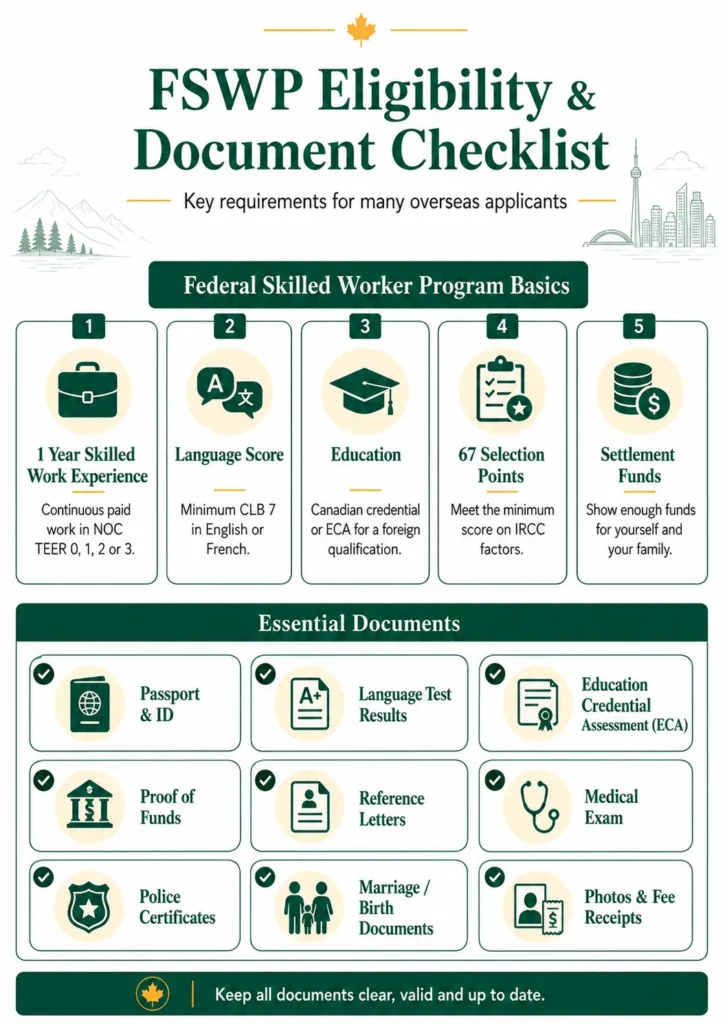
Good documentation can make the immigration process smoother. Most applicants should start preparing these items early:
- Educational Credential Assessment: If you studied outside Canada, you may need an ECA from an approved organization to show how your education compares with Canadian standards.
- Language test results: Book IELTS General Training, CELPIP General, TEF Canada or TCF Canada depending on your language plan.
- Passport and civil documents: Keep your passport, birth certificate, marriage certificate and dependent children’s documents ready.
- Employment reference letters: These should clearly mention your job title, duties, salary, working hours, employment dates and company details.
- Proof of funds: Bank statements and financial records should clearly show that you have access to the required settlement funds.
- Police certificates and medical exam: Most permanent residence applicants need police certificates and an immigration medical exam from an approved panel physician.
- Translations: Any document not in English or French usually needs certified translation.
Step-by-Step Canada PR Process
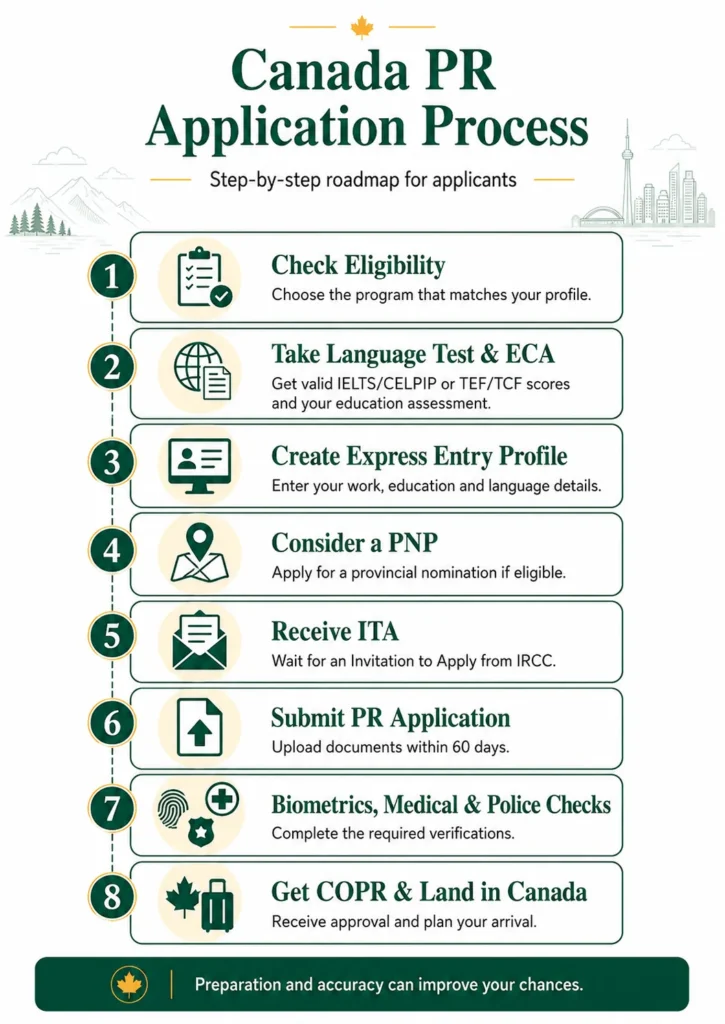
A common process for skilled applicants looks like this:
- Check which immigration program fits your profile.
- Take a language test and aim for the highest possible score.
- Complete your Educational Credential Assessment.
- Create an Express Entry profile if eligible.
- Check PNP streams that match your occupation and background.
- Apply for a provincial nomination if suitable.
- Wait for an Invitation to Apply.
- Submit your permanent residence application within the deadline.
- Provide biometrics, police certificates, medical exam and other documents.
- Wait for IRCC’s decision.
- Receive Confirmation of Permanent Residence if approved.
- Plan your landing, housing, job search and settlement.
Practical Tips for South Asian Applicants
Start with language preparation. A strong IELTS, CELPIP or French score can make a major difference in your immigration chances. Do not rely only on one pathway. Compare Express Entry, PNPs, Atlantic Canada, study options and employer-driven routes before deciding.
Avoid fake job offers and unlicensed agents. IRCC will not ask you to deposit money into a personal account. Work only with licensed immigration consultants or qualified lawyers. Choose your Canadian city carefully. Toronto and Vancouver have large South Asian communities but higher living costs. Calgary, Edmonton, Winnipeg, Saskatoon, Halifax and Moncton may offer more affordable options depending on your field.
Plan finances beyond proof of funds. You may need money for flights, rent deposit, winter clothing, transport, licensing exams, childcare and the first few months of living expenses. Check rules before applying. Immigration programs open, close and change frequently. A pathway that worked for someone in 2023 may not be available in 2026.
Final Thoughts
Canada offers several immigration pathways for South Asian applicants, but there is no single best route for everyone. A young skilled worker with strong English may focus on Express Entry. A nurse or hospitality worker may explore Atlantic Canada or provincial streams. A student may plan a study-to-PR route. A family may consider sponsorship or a Super Visa.
The best approach is to start early, improve your language score, prepare documents properly and choose a pathway that matches your real profile. With the right planning, Canada immigration can become more than a dream. It can become a structured, achievable move toward a better future.
Disclaimer: This article is for general information only and should not be treated as legal or immigration advice. Always check the latest IRCC rules or speak with a licensed Canadian immigration professional before applying.